
Tooth Extractions – Woodbridge, CT
Gentle Extractions to Protect Your Oral Health
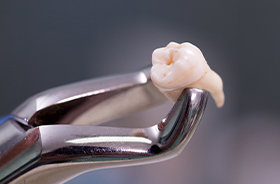
In most cases, we are able to repair any teeth that have developed decay or damage. Sometimes, though, a tooth (or teeth) can be in such a state that the only viable option is to perform gentle tooth extractions to protect your oral health. When this is necessary, our Woodbridge team takes measures to keep a patient comfortable from beginning to end of the surgical procedure, including answering all questions beforehand and using plenty of local anesthetic.
Why Choose New Haven Dental Group for Tooth Extractions?
- Sedation Dentistry Creates a Comfortable Experience
- Extractions Are a Last resort
- Natural-Feeling Tooth Replacements Available
Reasons Why Tooth Extractions Are Necessary

There are a number of reasons why we may recommend that a patient undergo one or more tooth extractions:
- A tooth has a cavity that is too big to be repaired with a filling, inlay, onlay, or crown.
- A tooth’s enamel is so badly damaged that it cannot support a restoration.
- A severe infection, such as advanced gum disease, has weakened the bone supporting the tooth.
- A baby tooth is interfering with the development of a permanent tooth
- More room is needed in the mouth for a denture or upcoming orthodontic treatment
- A wisdom tooth is threatening a patient’s long-term oral health.
- We wish to stop an infection in a tooth from spreading into the surrounding tissues.
The Process of Removing a Tooth

We begin the extraction process by numbing a patient’s mouth. We may also administer sedation. Then, we usually take an instrument called an elevator to lift the tooth out of its socket. Next, we use forceps to rock the tooth back and forth in order to break the tissues that are holding it in place. Once the tooth is out, we use gauze to control bleeding.
Some cases are a little more complex. We might have to break a tooth into pieces or create incisions in the gums in order to perform a successful extraction.
Following tooth removal, we can begin the process of planning to fill in the gap in your smile with a bridge or dental implant.
Tooth Extraction Aftercare

Here are some practical things you can do to facilitate a smooth recovery after a tooth extraction:
- Take prescribed medications as instructed by our team.
- After the first 24 hours, begin regularly rinsing your mouth with warm salt water.
- Get enough rest, and prop your head up with pillows when you are lying down.
- Do not smoke.
- Do not use drinking straws.
- Do not touch your extraction sites with your tongue or fingers.
- Attend all recommended follow-up appointments with our team so we can move forward with your tooth replacement. We want to help you avoid complications like dental drift and further tooth loss.
Understanding the Cost of Tooth Extractions

The cost of tooth extractions is manageable for most patients. During your consultation, we can share some specific numbers that are based on your unique treatment needs. We will also be happy to explain your payment options, such as insurance and financing. We want the monetary aspect of your care to cause as little stress as possible, so feel free to ask us any questions that may come to your mind.
Factors That Can Affect Tooth Extraction Cost
Some factors that might have a bearing on the cost of your extraction procedure include:
- The specific tooth that needs to be removed. Some teeth are more difficult to extract than others, so they may incur higher fees.
- The number of teeth that must be extracted. Logically, removing several teeth costs more than removing just one or two.
- The overall complexity of your case. Some teeth are impacted (stuck beneath the gumline), which leads to a much more complex extraction process. Therefore, higher costs are to be expected. (This is often the case with wisdom teeth). If we need to refer you to an outside specialist, their pricing structure may be very different from ours.
- Additional care. Sedation during your extraction, as well as tooth replacement afterward, can add significantly to the total cost of your care. There are different types of sedation and tooth replacement that come at a range of price points.
Does Dental Insurance Cover Tooth Extractions?

Very often, yes, dental insurance does cover tooth extractions. Simple extractions are usually classified as a basic service, so up to 80% of their cost might be covered. Surgical extractions are a major service and might be just 50% covered. Our team welcomes insurance, and we will be happy to help you understand how your benefits apply. We are even in-network with many popular plans. With the help of their insurance, many patients are able to reduce their out-of-pocket fees by hundreds of dollars.
Other Options for Making Tooth Extractions Affordable

If you do not have insurance or are looking for other ways to make tooth extractions more affordable, you might take advantage of one of the following provisions:
- We work with third-party lenders, including CareCredit and Sunbit, to provide low-interest payment plans. The application process is fast, and the majority of patients are approved for a line of credit that works with their budget.
- Essential Dental plan. This in-house discount plan provides reduced fees on almost all of the services available in our practice. Signing up is easy, and you can start to use your benefits right away.
Are you interested in learning more about tooth extractions and their cost? Get in touch with our Woodbridge dental team — we will be happy to answer your questions!
Tooth Extractions FAQs
Does getting a tooth extracted hurt?
Our Woodbridge team aims to make tooth extractions as comfortable as possible. To that end, you can expect us to thoroughly numb your mouth before we start working. The local anesthesia blocks pain signals. However, it does not prevent feelings of pressure, so you might feel some light sensations as we remove your tooth.
After the numbing agent wears off, you can expect to experience some soreness and swelling. Most people are back to feeling normal within a week or two. In the meantime, you can reduce discomfort by taking pain medications, getting adequate rest, and consuming a soft diet. If you struggle with severe or ongoing pain, let our team know so we can provide the needed assistance.
Is there an alternative to a tooth extraction?
As a responsible dentist in Woodbridge, our team typically recommends tooth extractions only as a last resort. Often, we can preserve damaged teeth with restorative procedures, such as root canal therapy, crowns, fillings, and other services. However, if such measures are inadequate for the situation at hand, an extraction is likely the best option.
If you hope to avoid tooth extractions, we recommend that you be proactive about your oral health. Regular checkups, prompt treatment to address problems, and a good daily oral hygiene routine can do much to reduce the risk that one of your teeth will need to be removed.
What are my options for replacing a missing tooth?
There are a few different ways to replace a missing tooth:
- A fixed bridge has a crown on each end; they get attached to the teeth that surround the empty space. One or more artificial teeth spans the gap. A fixed bridge is quite sturdy and has the potential to last for 10 years or longer.
- A full or partial denture is a removable prosthetic that stays in place with the help of natural suction, adhesive, or small clasps. Dentures are relatively affordable and can provide pleasing aesthetics.
- Dental implants are the most reliable tooth replacement solution. They rebuild lost teeth from the roots up and provide remarkable bite strength. They also look and feel very natural and have the potential to last for a lifetime.
Can I leave the space empty after a tooth extraction?
If you get extra teeth or wisdom teeth removed, there is no need to worry about getting them replaced. In almost all other circumstances, tooth replacement is very important to support oral and overall health.
If you leave the space empty, the nearby teeth could start to drift out of place. This can interfere with your bite, increase the risk of dental damage, and even lead to additional tooth loss. Your jawbone will also start to deteriorate. Timely tooth replacement with dental implants can prevent all such issues.